There are two stories about AI being told to incumbent companies right now, and both are wrong.
The first is from the consultants: "AI will transform everything; rebuild from scratch or die." The second is from the sceptics, often quietly, often in the executive corridor after the all-hands: "This is a fad; we have survived twenty of these; keep your head down." Both are flattering to the people telling them and useless to the people running actual businesses.
The boring, unsexy, almost-impossible-to-sell truth is the third story. The real money — for established companies, for SMBs with twenty years of customer relationships, for the operators who already have a P&L that works — sits in the synthesis. Not the rebuild. Not the resistance. The merge.
Legacy isn't bad. AI isn't divine. The companies that win the next decade will be the ones that stop treating those two sentences as opposites and start treating them as a barbell.
The replacement fallacy
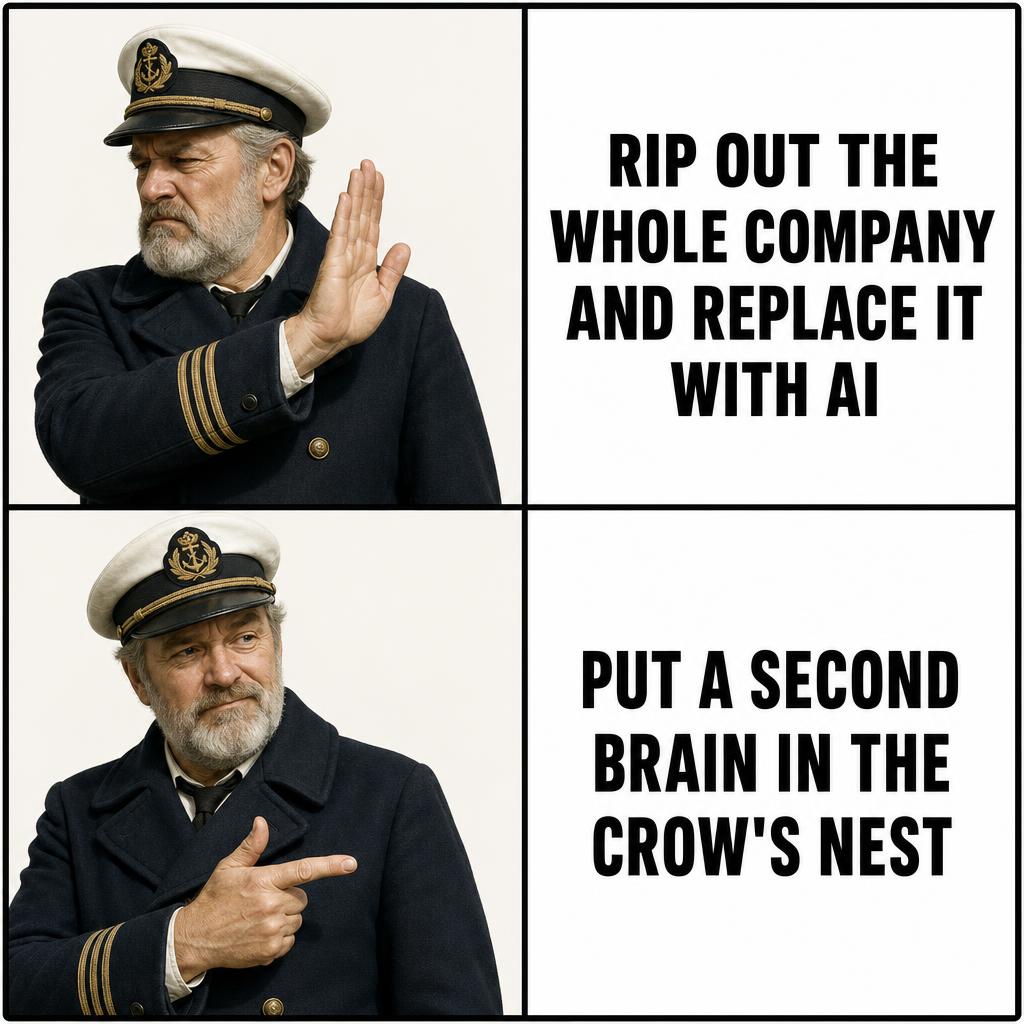
The dominant narrative of the last 24 months has been replacement: AI replaces customer service, AI replaces the analyst, AI replaces the writer, the coder, the accountant, the designer. It is a useful story for software vendors selling seat-based subscriptions because every replaced human is a billable seat. It is a terrible story for the businesses being sold to, because almost none of them are replacement plays in the first place.
A 30-year-old plumbing company does not need to "replace" its dispatcher with AI. It needs the dispatcher to walk in on Monday with three more good leads, two cancellations rebooked, and an accurate guess at which truck will break down this week. The plumbing company is not the obstacle to that outcome — it is the substrate that makes the outcome valuable. Without the trucks, the relationships, the licences, the suppliers, and the ten thousand small judgements baked into the route planning, "AI dispatcher" is a demo. With them, it is a bigger business.
Replacement-thinking strip-mines the substrate. Synthesis-thinking compounds it.
What "old" actually contains
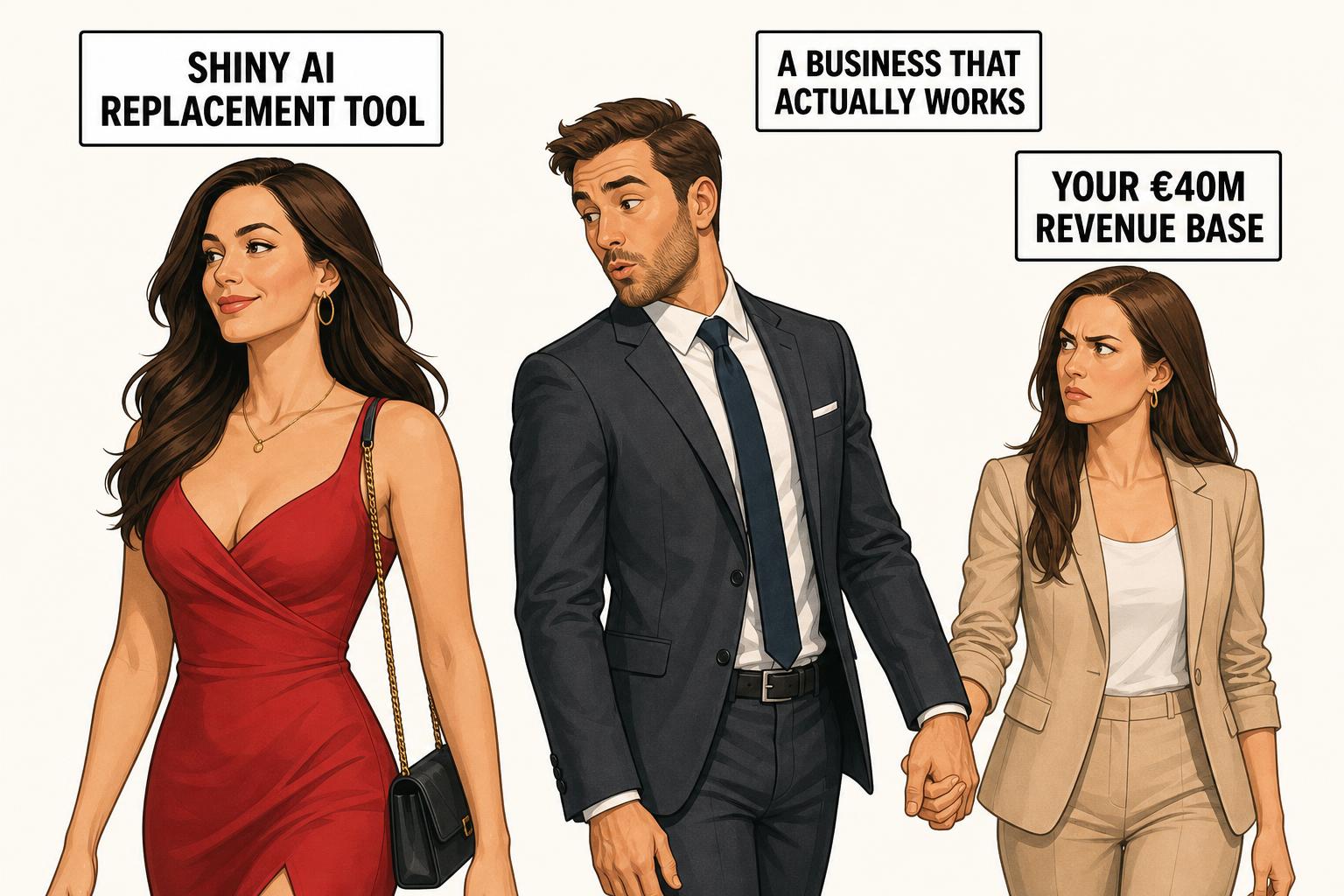
"Legacy" is a slur in tech and a synonym for moat everywhere else. Strip the connotation off and look at what an established company actually has on its books that an AI-first start-up does not:
- Compounded customer trust. Twenty years of showing up when the boiler broke. You cannot prompt that into existence.
- Tacit operational knowledge. The thing the third-shift supervisor knows about the line that nobody has ever written down. It is in their hands, not in your wiki.
- Distribution that already works. A route, a shelf, a referral network, a phone that already rings.
- Owned infrastructure and operational fleets. The depot, the warehouse, the trucks, the rigs, the machines on the shop floor, the technicians in the vans. Capital equipment that is already paid down and crews who already know how to run it. A pure-software competitor cannot conjure this on a 24-month roadmap.
- Regulatory standing. The licence, the BAA, the ISO certification, the bonded relationship with the city.
- A balance sheet that survives bad quarters. Boring until the day it isn't.
Each of these is, in 2026 terms, an unfair advantage. None of them are produced by tooling. All of them are degraded by replacement plays that treat the existing business as a cost centre to be evacuated.
What "new" actually delivers
On the other side of the barbell, AI is not a magic show. It is, in prosaic terms, four specific capabilities that legacy operations have never had cheaply:
- Decision-grade synthesis at scale. Reading every customer email, every ticket, every transcript and surfacing the three patterns the CEO needs to know on Monday morning. A team of analysts could do this. They cost €400k a year. They don't, actually, do this.
- Adversarial pressure on demand. A professional-pessimist sparring partner for any decision — available before the lease is signed, the hire is made, the launch is scheduled. (The kind of structured red-teaming we wrote about in The Professional Pessimist.)
- Persistent memory of every interaction. Not replacing the relationship — supplementing it. Remembering that this customer's daughter graduates this June so the renewal call doesn't happen that week.
- Translation between worlds — synthesis across siloed knowledge domains. Turning the third-shift supervisor's tacit knowledge into something the night-shift can use; turning the legal contract into something the sales team can quote from; turning twenty years of invoices into a margin map. Stitching what finance knows, what ops knows, what the field crews know, and what the customer keeps saying into a single picture nobody inside the building has ever been paid to assemble.
- Detection of the things that sit unflagged. The lagging operational bottleneck nobody has had the time to chart. The recurring financial error buried four levels deep in the reconciliation. The customer-service complaint that shows up in fourteen tickets across three regions but never rolls up to a single owner. AI is a fantastic co-pilot as detection layer: it watches the substrate your business already produces — invoices, tickets, call transcripts, sensor logs, calendar slips — and surfaces the patterns a human team is too close to the work to see. Not to judge the team. To give the team the heads-up the team would want.
None of these replace the business. Each of them amplifies a thing the business already has. Read those five capabilities together and the shape becomes obvious: AI is a good decision substrate precisely because it is a second pattern-recognition brain running on the collective knowledge of how your company actually operates — sitting next to an irreplaceable human talent team, not in front of them. The humans keep the judgement, the relationships, the accountability and the taste. The substrate keeps the watch.
The barbell, written out
We owe the cleanest articulation of this to Codie Sanchez and the Contrarian Thinking team, who put it as a literal barbell strategy: on one end, leverage AI for what AI does best — ruthless scale and speed. On the other end, become aggressively, inconveniently human. Show up in person. Send the note. Remember the name. Do the thing that doesn't scale.
We think the same shape applies one level up — at the company level, not just the founder level. The synthesis bet is:
- Keep the old-school spine. The handshake, the callback, the 25-year supplier relationship, the in-person handover. These are the moats. Defend them.
- Bolt on the new-school nervous system. AI-grade memory, AI-grade synthesis, AI-grade adversarial pressure on the big calls. Use the tooling for what tooling is good at.
- Refuse the middle. The middle is where most companies will end up: half-automated customer service that's worse than the old kind and less efficient than the new kind. A newsletter ghostwritten by AI that nobody opens. Dashboards nobody reads. The middle is the trap.
The integration question, asked properly
When an established company asks "should we use AI?", the question is wrong. The right question — the one that produces useful answers — has three parts:
- Which of our existing strengths is currently under-leveraged because we lack capacity, not capability? Those are the synthesis candidates. AI buys you capacity against a strength you already own.
- Which of our weaknesses is structural, and which is informational? Informational weaknesses ("we don't know which customers are about to churn") are AI-shaped problems. Structural ones ("our product is wrong for this market") are not, and tooling will not save them.
- Where would a wrong AI answer be unrecoverable? Those are the seats AI does not get to occupy alone — the final call on hiring, firing, pricing, partnerships, ethics. AI informs them; humans own them.
Three questions, one afternoon. They will produce a shorter, cheaper, more honest AI roadmap than any €200k consulting engagement currently being sold.
Three quiet examples of the synthesis at work
The dispatch problem
A regional HVAC company we know runs eleven trucks. The dispatcher is the founder's cousin. She has been there fifteen years. She knows which customer hates which technician, which neighbourhood traffic at 4pm, which truck the new hire shouldn't be allowed to drive yet. They added an AI assistant that does none of those things and instead reads every overnight email, every voice message and every form-fill, then drops a ranked, summarised brief on her keyboard at 6:45am. She still routes the trucks. She just starts the day with the picture already assembled. Same dispatcher; ninety more minutes of her judgement applied per day.
The pricing call
A small specialty manufacturer raises prices once a year and dreads it for six weeks. They started running every proposed price change through an adversarial review — a structured red-team that argues the case against the increase as harshly as possible, on the customer's behalf. Most increases get smaller and more targeted; some get bigger; one was killed entirely because the adversarial pass surfaced a competitor signal nobody on the team had registered. The CEO still makes the call. The call is measurably better.
The handwritten note that got faster
A 60-person agency sends a handwritten thank-you card to every client on the anniversary of the contract. They use AI to draft the personal paragraph in each card based on the actual work that year — which the principal then edits, signs, and posts. The humanity is real (it's their handwriting, their signature, their post). The leverage is real (they used to send 40% of the cards because nobody had time; now they send 100%). Neither end of the barbell is sacrificed.
Where THE ROAST sits in all of this
We did not build THE ROAST to replace the people who already make decisions inside your company. We built it to give them a structured second brain — a council of professional pessimists, archetypal advisors, and (where the law allows) historical voice packs — that lives next to the existing process, not on top of it. Think of it less as a new system to adopt and more as an extra cognitive field laid over the processes you already run — the same meetings, the same rituals, the same people, with one more voice in the room that has read everything and is paid to disagree.
That means three concrete things for an established business thinking about working with us:
- We don't ask you to rip anything out. Not your CRM, not your ERP, not your decision rituals. The Roast plugs into the moments where adversarial pressure is currently missing — the lease, the hire, the launch, the pivot — and stays out of the rest.
- We treat your tacit knowledge as the spine, not the obstacle. The third-shift supervisor's instinct, the founder's gut, the long-time controller's pattern recognition — these are inputs to the council, not things the council overrides. We will tell you when they disagree with each other, and that is the entire product.
- We log every call, name every model, cite every source. No black-box "the AI said so." A decision-grade tool has to be auditable, or it is a vibe wearing a tie. Every response in the council records the model used, the prompt version, and the retrieval set. That is a property of decision-grade software, not a feature.
The category we are actually in
We are not a "replace your team" tool. We are not an "automate your workflow" tool. We are a decision substrate — a piece of infrastructure that makes the decisions a real operator already has to make sharper, faster, and harder to argue with after the fact. It is meant to be married to your existing operation, not parachuted on top of it.
For the founder of a 4-year-old SaaS company, that means: bring the council into your weekly leadership meeting, not your stand-up. For the owner of a 30-year-old service business, that means: use it to pressure-test the next acquisition, the next price change, the next senior hire — not to write your customer emails. For the CFO of a mid-market firm, it means: a structured pre-mortem before the board approves the capex, in addition to the management commentary, not instead of it.
The barbell, again. Old-school spine. New-school nervous system. Refuse the middle.
One closing belief
The companies that will look obvious in hindsight — the ones that the press will write up in 2031 as "AI winners" — will mostly not be AI-first. They will be 5-, 15- and 50-year-old businesses with adult P&Ls, real customer relationships, and a quiet decision layer underneath that uses the new tools without ever genuflecting to them.
That is the bet THE ROAST is built on. Legacy is the moat. AI is the amplifier. The synthesis is where the money lives — and the only people who will believe that early enough to act on it are the operators who already had the moat.
If that's you, you don't need to rebuild your company. You need a better second brain.