On adversarial second brains, the cost of avoidance, and why the most valuable AI characters of the next decade will not be built by AI companies.
For a long time, I worked alone.
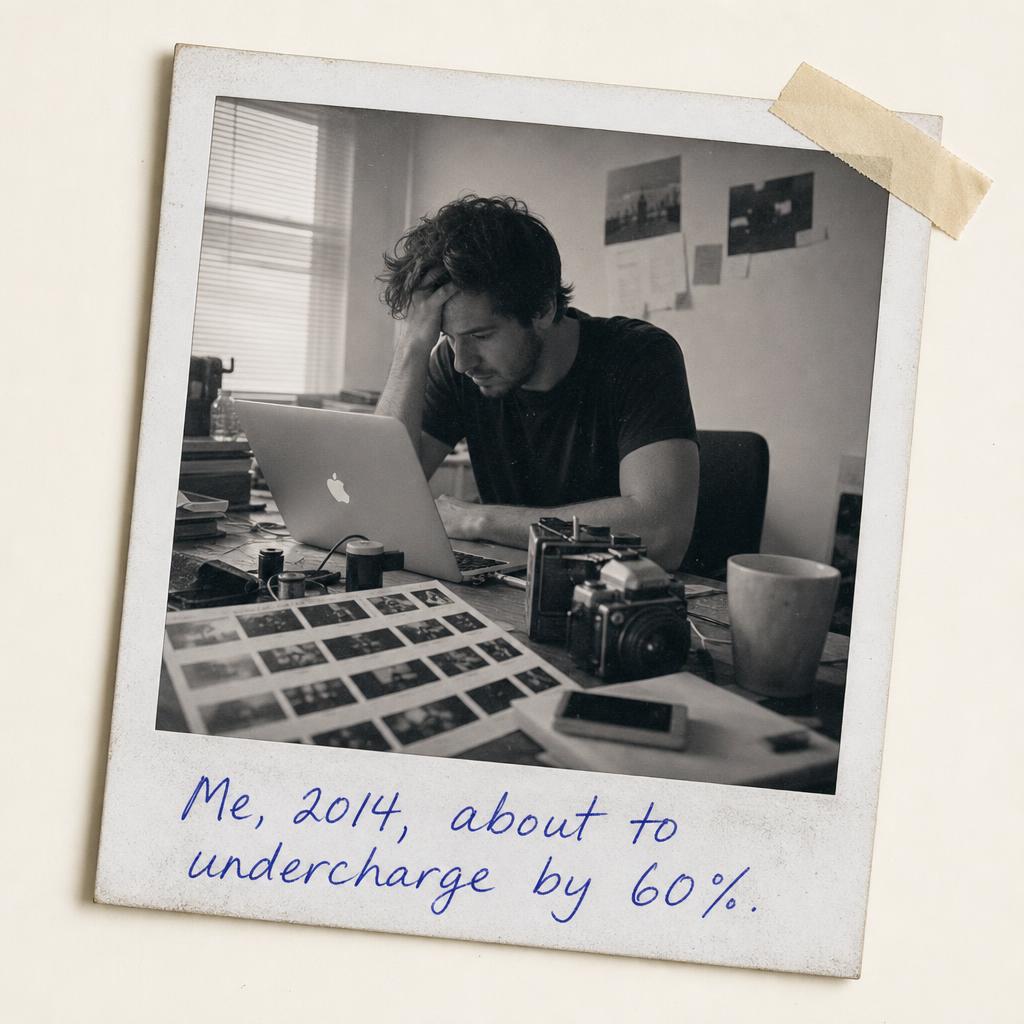
I was a photographer. Solo operator, single income stream, the kind of business where every decision — pricing, positioning, which client to take, which to walk away from — lands entirely on one pair of shoulders. One view. One perspective. One person making calls that a properly staffed company would route through a financial director, a contracts specialist, a strategist, a marketing team, and at least one person whose entire job is to tell the founder what they do not want to hear.
I had none of that. What I had was the work, and a growing awareness of exactly how much I did not know. (And a Mamiya I could not really afford. But that is a different essay.)
So I did something that made no obvious sense at the time. I started building what I now recognise as adversarial second brains.
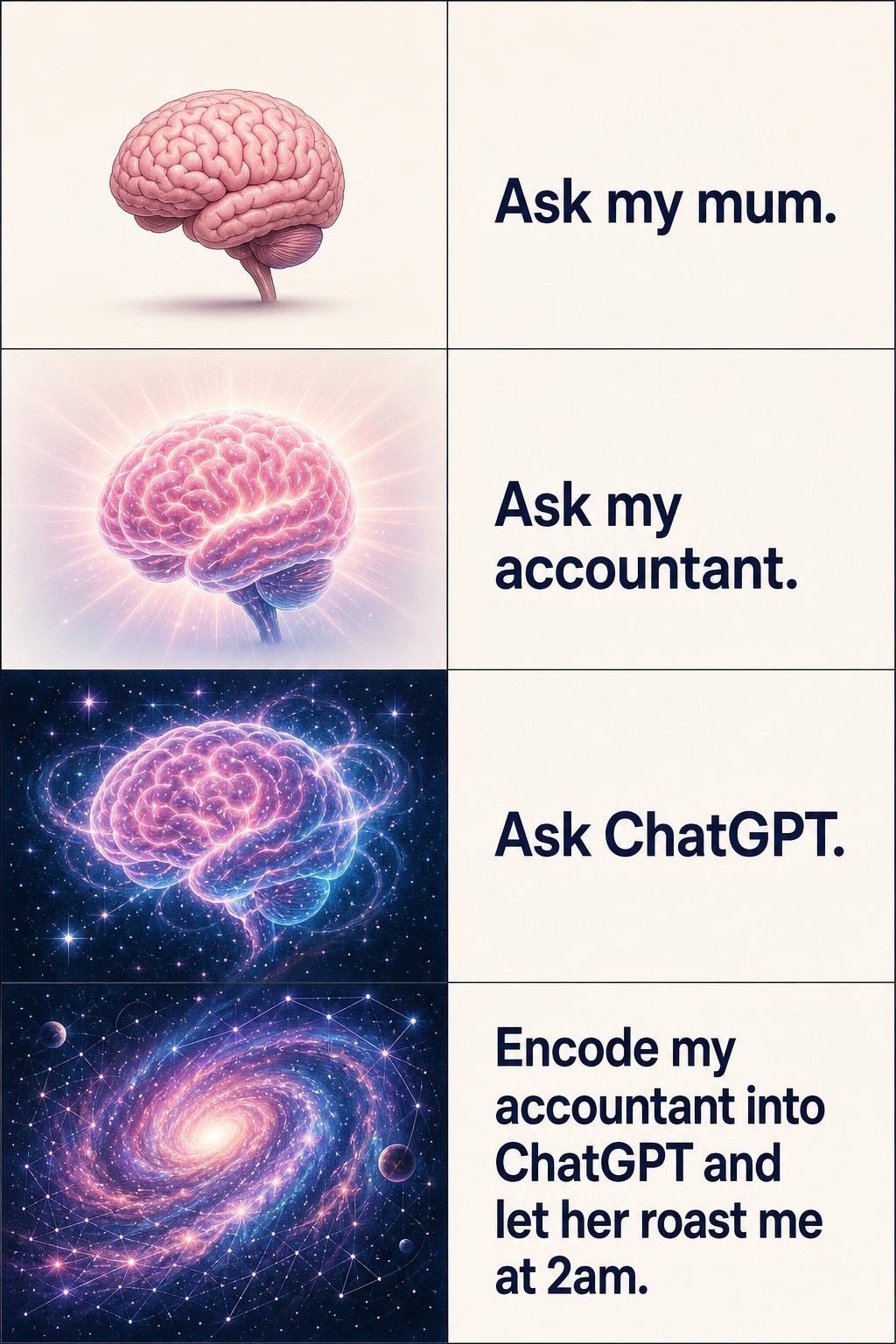
Not creative collaborators. Not yes-men. Deliberate, structured, mentally-inhabited specialist voices whose explicit function was to stress-test the things I was building. A rigorous financial operator who would run the numbers on a business plan I was developing and flag the cash flow assumptions I was quietly hoping no one would notice. A risk analyst who would model the second and third-order consequences of a venture I was considering that sat just outside my core competency. A contracts lawyer who would read the agreement I was about to sign and tell me what I was actually agreeing to, rather than what I wanted it to say. A strategist with no emotional investment in my current direction who would examine whether the adjacent opportunity I kept circling was genuinely a better bet, or just a more comfortable one.
These were not real people. I had no money to hire real people. They were constructed internal voices — built from everything I had read, everyone I had observed, every failure I had reverse-engineered — and they were adversarial by design. Their job was not to encourage me. Their job was to find the flaw before the market did.
That discipline made me harder to fool, including by myself. When AI tooling arrived with the capacity to do something structurally similar at a fidelity no internal monologue could match, I did not see a new technology. I saw the product I had been prototyping for years.
The most expensive problems are the ones being avoided
Here is something most companies know and almost none will say out loud: the most expensive problems in any organisation are not the ones being worked on. They are the ones being avoided.
I have worked with and inside enough companies to see the pattern repeat with uncomfortable precision. The agency where production and customer service operated as hostile nations, conducting their wars through passive-aggressive email chains while the client bore the fallout. The sales team that promised what the product team had already decided was impossible, and both departments had meetings with the CEO where neither told him the full truth. The financial controller who kept flagging a cash flow issue in politely worded memos that everyone agreed were serious and no one acted on — because acting on them required a conversation that would have been awkward.
The pink elephant sits in the room. Everyone sees it. Nobody names it.
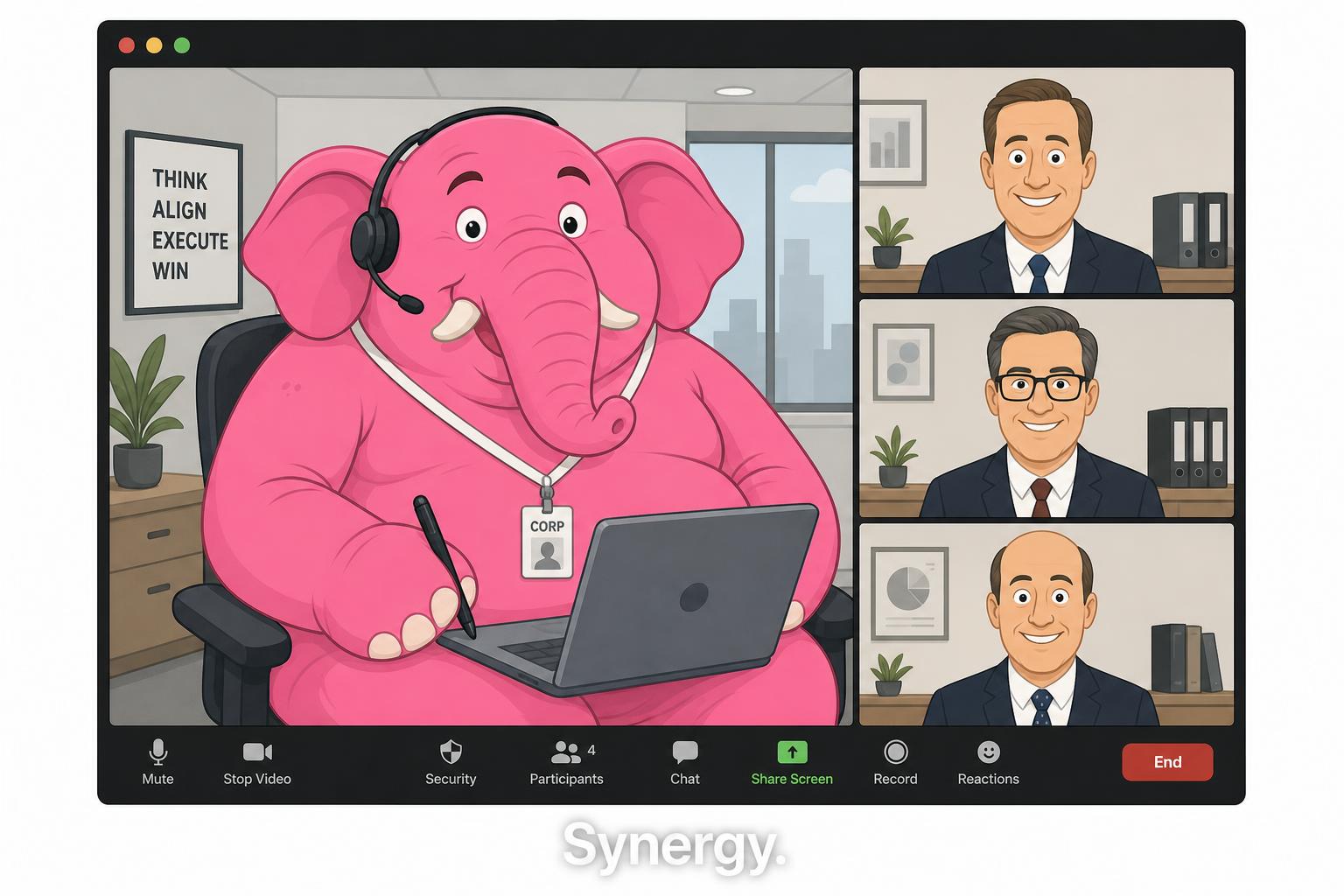
This is not a character flaw. It is a structural one. Organisations are made of humans, and humans are wired for social harmony — especially in hierarchies. The cost of saying the uncomfortable thing out loud is usually borne by the individual who says it. The cost of not saying it is borne by the organisation over time. So the rational individual stays quiet, and the company slowly accrues the debt of its own avoidance.
The result is siloed thinking, misaligned incentives, and decisions made in the comfortable warmth of consensus rather than the cold light of an honest second opinion. The people who suffer most are not those insulated at the top, but those in the middle who can see the problem clearly and have no legitimate, low-risk channel to surface it.
I am interested in changing that. Not with a management framework or a motivational keynote. With infrastructure.
Bet on human ingenuity
Charlie Munger had a phrase he returned to throughout his life: bet on human ingenuity.
He did not mean it as sentiment. He meant it as a rigorous investment principle. When Munger and Buffett looked at a business, they were not predicting which specific technology would win or which product would dominate a decade from now. They were asking a more durable question: does this business sit in the path of what people, given the right tools and the right incentives, will inevitably build? Does it compound alongside human creative and productive capacity rather than depending on any particular expression of it?
A mentor I never met, Munger gave me the intellectual permission for the bet we are making with TheRoast.
Because what is converging right now is not one trend. It is several, arriving simultaneously, producing what Munger would have recognised as a lollapalooza: AI tooling that has collapsed the cost of deploying expertise, a creator economy that has already demonstrated that individual human talent can build institutional-scale businesses, legislation defining digital persona rights being written across jurisdictions as you read this, and enterprise demand for advisory infrastructure that is genuine, specific, and does not require a full-time hire. These forces are not additive. They are multiplicative. And the marketplace infrastructure for the asset class they are creating does not yet exist.
That is the gap we are building into. And the reason the bet is on human ingenuity rather than on AI is precise, not rhetorical.
What AI changes, and what it doesn't
AI will not replace human creativity. This is not wishful thinking — it is a structural fact about what AI is. A model is, at its core, a sophisticated pattern-recognition and generation system trained on the outputs of human thought. It has no subject position. It has no stake in the outcome. It does not know what it is like to be wrong about something important, to build something for twenty years and watch it fail, to understand a particular industry from the inside because you have spent a decade inside it.
The knowledge that makes an advisor genuinely valuable — not a generic advisor, but the specific kind who has seen this exact problem before and carries the scar tissue to prove it — is irreducibly human. It is subject-position bound. It can be scaled and deployed through AI tools, but it cannot be generated by them from scratch. The signal that distinguishes genuine expertise from plausible-sounding pattern-matching is always, on close inspection, the specificity that only comes from having lived through something particular.
What AI changes is not the nature of creativity or expertise. It changes the cost of deploying them.
For most of human history, the scale of a person's impact was bounded by the hours in their day. The financial operator who understood creative businesses — who had watched a hundred agencies make the same cash flow mistakes, who could flag the moment a company was six months from a crisis before the crisis was visible in the numbers — could advise exactly as many organisations as she had hours for. The cultural analyst who understood how information flows, or fails to flow, in flat organisations could reach only the clients willing to pay her day rate. The strategic thinker who had spent thirty years developing a genuinely useful framework for stress-testing second and third-order thinking could not be in three hundred rooms at once.
That constraint is lifting. And it is lifting in a way that is, if you look at it honestly, quietly extraordinary.
The same depth of knowledge, the same specificity of perspective, the same hard-won personality — all of it can now be encoded, deployed, and made accessible to anyone who needs it. Not as a replacement for the human. As an amplifier of them. A way of extending what was always there but was never before scalable.
Who this changes things for
Think about who this changes things for. The large company with a board of advisors and a Chief Risk Officer and a legal department is not exempt — in some ways it needs this most. The bigger an organisation grows, the more its internal voices converge. Tenure breeds comfort. Hierarchy filters dissent before it reaches the people who need to hear it. The board meeting where every person in the room has built their career inside the same industry, the same assumptions, the same decade of compounding consensus — that room needs an indie voice, an outside perspective, a character with no career stake in the organisation's current direction, more than almost any other. Innovation does not die from lack of resources. It dies from the slow, invisible calcification of thinking in rooms where everyone already agrees.
But think also about the creative studio that is doing serious work, building real things, but cannot yet justify a full-time CFO — and is therefore making financial decisions without the disciplined, unsentimental analysis those decisions deserve. The founder running a tight operation who needs someone to stress-test a contract, not every week but at the specific moment it matters, without the cost of a retainer or the social friction of asking yet another favour. The team that is intellectually sharp in its own domain but has no one internally who will consistently, constructively push back on its assumptions — not because the people are incurious, but because the organisation has never had the infrastructure for deliberate, structured challenge.
Access to genuinely good advisory intelligence has always been unevenly distributed. Not because the talent was scarce — it was never scarce. Because the infrastructure for connecting that talent to the people who needed it, at a cost and format they could actually use, did not exist.
The bet TheRoast makes
Not on AI. Not on any specific technology stack, model architecture, or current wave of tooling. On the people who will use these tools to build something no corporation could build for them — because no corporation can replicate the specificity, the depth, the genuine particularity of a perspective forged by a particular life.
We are building the marketplace for that.
The voice actor who has spent fifteen years inhabiting characters — who understands vocal texture and emotional register from the inside, not from a dataset — can now encode that depth into a character, list it on TheRoast, and earn from every organisation that deploys it to train a team, run a workshop, or stress-test a strategic decision. She owns the IP. She sets the terms. She gets seventy percent of everything it earns. The platform does not extract. It enables.
The cultural anthropologist who has spent a decade studying how information actually flows in flat organisations — who has built a framework for surfacing misaligned incentives that she has never been able to productise — can now deploy that framework as a distinct character voice that asks the questions most advisors are too politic to raise. Not provocatively. Precisely. The organisations that are silently haemorrhaging value to the very dynamic she spent a decade studying are, it turns out, willing to pay for the voice that names it.
The narrative designer who has built a character over five years of serialised fiction — a voice with genuine emotional depth, a consistent worldview, an audience that has come to trust it — owns licensable, enterprise-deployable intellectual property. It has simply, until now, had nowhere to go.
And on the other side: the company that needs a decision-making infrastructure, not just a tool. The leadership team that has grown too comfortable with its own consensus and needs, built into the rhythm of how it works, a voice that will say the thing the organisational culture has made structurally difficult for any human employee to say. Not to be difficult. To be useful. In the way that only honest counsel, without career risk, can be useful.
The Kaizen circle
We call it the Kaizen circle. A structured environment where different AI advisor characters — each built by a different human, each carrying a different depth of expertise — sit alongside the people who run the company and do what a good advisory board does: challenge the assumptions, flag the risks, name the pink elephant, and then help figure out what to do about it.
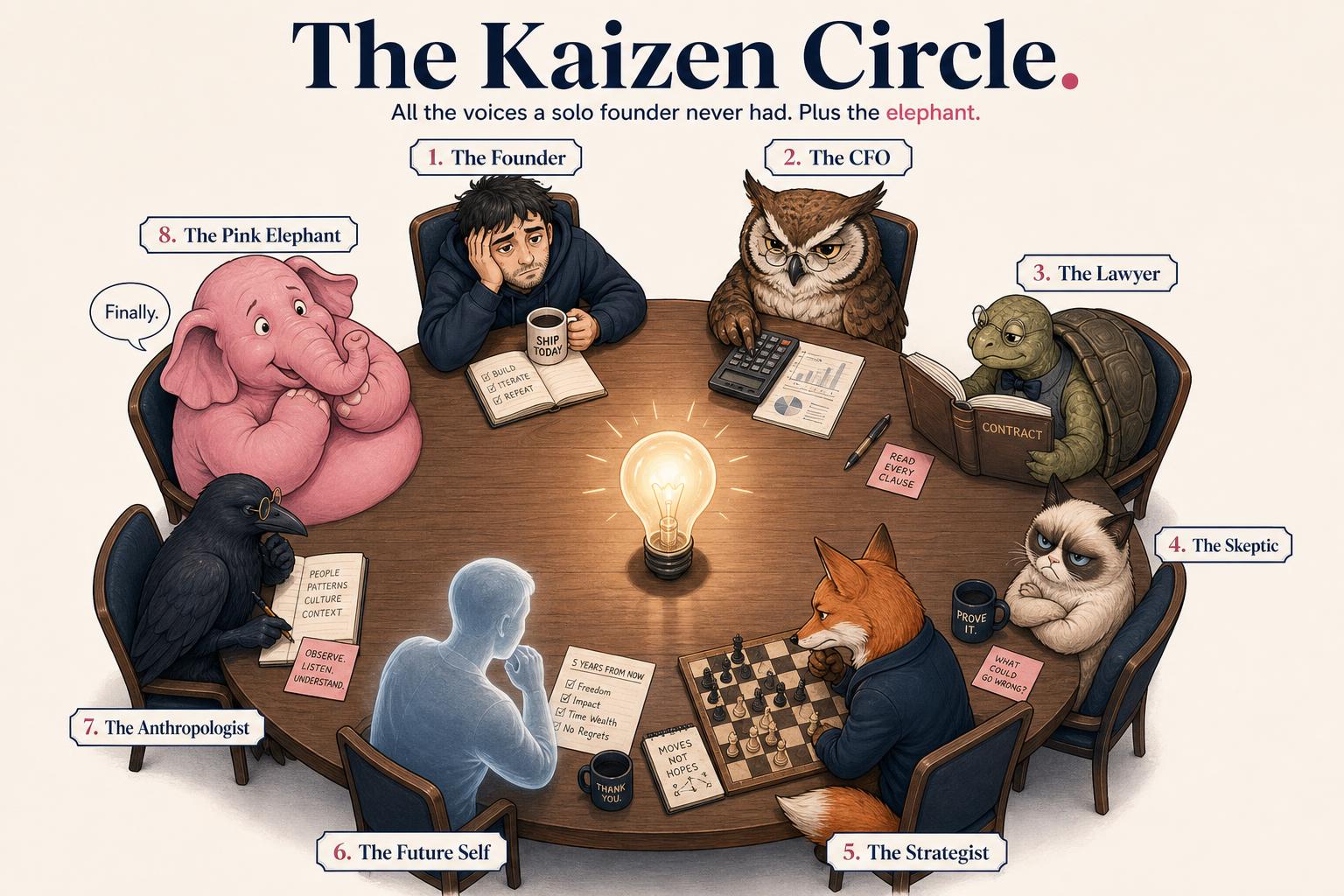
The goal is not disruption. The goal is access. A small company should be able to think with the same quality of adversarial intelligence as a large one. A solo operator should have the same capacity to stress-test a decision as a team of twenty. And a large company that has everything except genuine opposition should finally have a channel for it.
The talent is the source
The talent management industry had its own version of this moment. Before the modern agency, the relationship between talent and capital was extractive by default. The skilled individual had no infrastructure for turning their ability into a business on their own terms. The agencies that changed this understood something simple: if you build the infrastructure that fairly represents talent, and you build it with genuine care for the people on your roster, the value compounds in ways that no distribution company can match.
We think about TheRoast the same way. We are building the CAA of the AI character economy. Not the platform that owns the characters. The infrastructure that enables the people who build them to own their creative output, reach the buyers who need it, and earn from it in proportion to its actual value.
The talent is the source.
And the talent is everywhere. In Amsterdam and Lagos and Berlin and Seoul. In every person who has spent years developing a rare perspective that their professional context has never given them the tools to scale. In every operator who has looked at what the existing platforms offer — in terms of ownership, compensation, and fundamental respect for what they have built — and thought: there has to be something better than this.
The creator economy is $253 billion today and projected to reach two trillion by 2035. AI tooling in this space is growing at thirty percent annually. Legislation defining digital persona rights is being written in Brussels and Washington simultaneously. The infrastructure layer for AI character IP does not yet have a dominant platform.
This is the bet. On human ingenuity. On the compounding value of genuine depth. On the idea that the most important advisory voice you will ever access might be encoded by someone you will never meet, in a city you have never visited, from a life experience that is nothing like yours — and that is precisely why you need it.
We are TheRoast. We are building the marketplace for what comes next.
If you build characters, come build with us. If you run a company and you are tired of the pink elephant, come in. If you are an investor who bets on human ingenuity — you know where to find us.